Chemistry &
Lab Experience
A laboratory is a peculiar place where the ordinary loses its innocence. Rice becomes a biochemical puzzle, colors reveal molecular secrets, and invisible forces leave measurable traces. Across different laboratories, I learned to question appearances, embrace uncertainty, and find meaning in unexpected reactions. Each experiment became another chapter in my ongoing conversation with matter, where even failure had something worth revealing.

"Optimization of Fermentation Parameters and Sensory Quality for High γ-Aminobutyric Acid (GABA) Enrichment in Vietnamese ST25 Rice Substrate Using Bayesian Optimization"
A grain of rice had always seemed too ordinary to deserve a laboratory investigation. It belonged in steaming bowls at family dinners, not among bacterial cultures and analytical instruments. Yet Vietnamese ST25 rice held an intriguing possibility: could fermentation transform something so familiar into a source of bioactive GABA? I became fascinated by the biochemical journey of glutamate, which Lactobacillus brevis could convert into GABA through enzymatic decarboxylation. Preparing rice slurry and studying fermentation conditions gave this everyday ingredient an entirely different identity. I began seeing food not merely as nourishment, but as a remarkably complex chemical landscape waiting to be understood.


Fifteen experiments stood between us and an answer, but the challenge was deciding which conditions deserved testing. Instead of blindly repeating combinations, we used Bayesian Optimization to navigate inoculum concentration, acidity, and fermentation time. Each result narrowed the search, like footprints appearing across an unfamiliar landscape. The optimized process eventually yielded 6.48 mg of GABA per gram of dry substrate, with an 88.42% precursor conversion rate. Yet the most surprising lesson was not numerical. A successful transformation also had to preserve the rice's sensory appeal. I discovered that good food chemistry demands two kinds of intelligence: one that understands molecules and another that respects the human experience of tasting them.
“Bioactivity & Molecular Docking of Novel Urea Derivatives as Anticancer Agents”
I used to think molecular structures looked like miniature architectural drawings: rings, bonds, and branches arranged with almost impossible precision. During our research into novel urea derivatives, those diagrams became instructions for constructing actual compounds. The six-step synthetic route demanded careful transformations toward stilbene- and indazole-based structures. Each intermediate was a doorway to the next reaction, but none guaranteed passage. I came to appreciate organic synthesis as a peculiar form of architecture, where every bond must justify its existence.


A molecule can look convincing on paper and still disappoint in the laboratory. Reaction yields, purification results, and spectral evidence must all agree before its identity can be trusted. Working with NMR, IR, MS, and TLC characterization taught me to question even the most elegant proposed structure. Our compounds were investigated as potential hSP90 C-terminal inhibitors, but biological promise required evidence beyond successful synthesis. Chemistry taught me a valuable distinction: creating something new is an achievement; demonstrating what it actually does is a separate responsibility.
National Taipei University of Technology
Lab Assistant
Taipei introduced me to a different rhythm of scientific life. Working under Professor Hsu-Wei Fang at the National Taipei University of Technology, I encountered laboratory procedures that required both technical precision and intellectual humility. Synthesizing a salicylaldehyde benzoylhydrazone ligand and its Cu(II) complex meant navigating coordination reactions, precipitation, washing, drying, and yield calculations. What stayed with me was the importance of understanding why each step mattered. A precipitate was not simply a solid to collect; it was evidence of a chemical transformation requiring careful interpretation. I remain grateful for the opportunity to learn in an environment where laboratory discipline and scientific reasoning were inseparable.
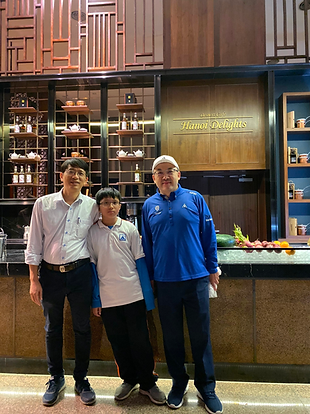


Some lessons remain valuable long after the glassware has been cleaned. Under Professor Fang's supervision, I explored Fe–SBH stoichiometry using Job's method and investigated cottonseed oil through saponification and iodine-value measurements. These experiments seemed unrelated at first: one concerned metal–ligand interactions, while the other revealed characteristics of fatty-acid composition. Gradually, I began appreciating the common principle beneath them: chemical conclusions emerge from carefully chosen measurements. Professor Fang's guidance gave me an opportunity to develop greater respect for that process. I left Taipei with more than laboratory experience. I carried gratitude for a mentor whose expertise had helped broaden the way I approached scientific questions.
Hanoi Universities
Muti-time Lab Assistant
A purple cabbage has no business being mistaken for sophisticated laboratory equipment, yet it became one of the most memorable materials in my chemistry experiments. After preparing its extract, I investigated how anthocyanin pigments changed color across different pH conditions, producing five observable color states. The transformation was beautiful, but beauty alone could not explain the chemistry. Using a pH meter and UV–Vis spectrophotometry, I examined how acidity influenced the molecular forms responsible for those colors. Alongside this work, reducing benzophenone with NaBH₄ introduced me to reaction monitoring through TLC and product assessment by melting point. One experiment delighted my eyes; the other demanded careful verification. Together, they taught me that visual observation becomes scientific evidence only when supported by analysis.


Iodine taught me that a chemical substance can behave differently depending on where it finds itself. During an experiment involving water, carbon tetrachloride, and potassium iodide, I investigated how iodine distributed between liquid phases and participated in triiodide formation. The separation of liquids offered a visible beginning, but titration was needed to uncover the quantitative relationships beneath it. Calculating the distribution constant and formation constant felt like mapping an invisible chemical territory. In another experiment, I prepared a cobalt acetylacetonate complex and examined its UV–Vis absorbance spectrum. These experiences challenged me to connect what could be seen with what had to be calculated. I learned that equilibrium is not stillness; it is a dynamic balance governed by molecular interactions.


Imagine a laboratory experiment reduced to a grid of ninety-six miniature reaction spaces. During qualitative metal-ion analysis, I used micropipettes to combine metal ions with selected reagents in a microplate, observing how distinct chemical reactions produced different visual responses. Every well became a small test of prediction and interpretation. A change in color might suggest a particular reaction, but reliable identification required comparing observations systematically. Preparing reagents and conducting analytical experiments, including redox and potentiometric titrations, further strengthened my attention to concentration, measurement, and experimental consistency. What fascinated me most was the economy of the method: tiny volumes could reveal meaningful chemical information. I began appreciating that sophisticated analysis does not always require large apparatus; sometimes, it requires a more disciplined way of observing.


Unknown compounds do not introduce themselves. They leave clues, and a chemist must decide which questions to ask. At Hanoi University of Science, identifying carbonyl compounds became an exercise in chemical deduction. TLC, Tollens' silver-mirror testing, DNPH derivatization, selective reactions, and mass-spectral interpretation each revealed different pieces of molecular identity. I enjoyed the intellectual tension of comparing evidence rather than relying on a single result. Investigating cobalt-complex magnetism offered another challenge: using Gouy-balance measurements to connect magnetic susceptibility with unpaired electrons, oxidation states, and orbital configurations. Here, even magnetism became a way of questioning matter. These experiments changed my understanding of laboratory work. Sometimes the most rewarding discovery is not producing something new, but finally recognizing what has been there all along.