Artistic
Endeavors
Not everything I love needs to make sense on paper. Some ideas demand a melody, others a brushstroke, a folded corner, or a flick of the wrist. I have spent years letting my hands wander where words cannot follow, turning restless imagination into performances, peculiar creations, and unexpected connections. Art, to me, is the freedom to make the impossible feel wonderfully ordinary.
Chrono
Founder, Head Organizer & Pianist
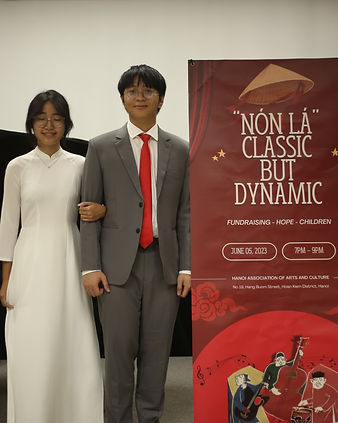
A pianist usually worries about the notes beneath his fingers. I began worrying about the people who might never enter a concert hall. That question became the beginning of Chrono, a fundraising music initiative for children with mobility impairments. I wanted the performances to feel unmistakably Vietnamese without being confined to a single musical tradition. The concept, “Nón Lá – Classic but Dynamic,” emerged from imagining how a familiar cultural symbol could inhabit a contemporary stage. I pictured the elegance of classical phrasing meeting the energy of modern arrangements, with traditional imagery woven throughout the evening. Music had always given me a place to express myself; Chrono offered the possibility of making that expression useful to someone else. For the first time, I was designing not simply a performance, but an experience whose purpose extended beyond the final applause.


A pianist usually worries about the notes beneath his fingers. I began worrying about the people who might never enter a concert hall. That question became the beginning of Chrono, a fundraising music initiative for children with mobility impairments. I wanted the performances to feel unmistakably Vietnamese without being confined to a single musical tradition. The concept, “Nón Lá – Classic but Dynamic,” emerged from imagining how a familiar cultural symbol could inhabit a contemporary stage. I pictured the elegance of classical phrasing meeting the energy of modern arrangements, with traditional imagery woven throughout the evening. Music had always given me a place to express myself; Chrono offered the possibility of making that expression useful to someone else. For the first time, I was designing not simply a performance, but an experience whose purpose extended beyond the final applause.


Behind the polished silence before a concert lies an astonishing amount of noise. There are chairs to rearrange, microphones to test, lighting cues to coordinate, and musicians whose interpretations of the same phrase may differ completely. Working with eight artists from the Vietnam National Academy of Music, I helped develop the repertoire and coordinate eighteen rehearsals. Sometimes the challenge was musical: balancing lyrical expression with rhythmic vitality or deciding how a passage should breathe. At other times, it was logistical, requiring attention to stage preparation, equipment, and schedules. I learned to listen beyond my own instrument, recognizing how each performer contributed to the character of the entire program. A concert is often described as a collection of individual performances. To me, Chrono became an exercise in making many independent voices sound as though they belonged to one conversation.




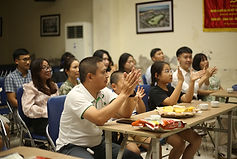
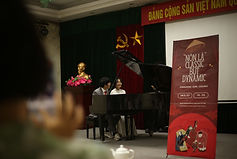
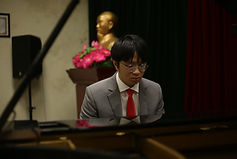
The most revealing moment of a concert may arrive after the music stops. The lights are dimmed, instruments are packed away, and the room gradually returns to its ordinary appearance. Across two three-hour fundraising nights, Chrono welcomed approximately six hundred audience members and raised $2,000 through ticket sales and additional donations. The funds supported children receiving care at the National Children's Hospital, children with disabilities at Thuy An Center, and patients at the National Institute of Hematology and Blood Transfusion. I had performed two piano pieces during the events, but the most lasting satisfaction came from knowing that the evenings served a purpose beyond entertainment. Organizing Chrono changed my understanding of artistic responsibility. A performance can be fleeting, disappearing almost as soon as the final note fades; its consequences, however, may continue long after the audience has gone home.
Original Piano Composition
I imagined a traveler arriving in an unfamiliar city, carrying memories of streets he had left behind. That image became Nơi Bình Minh Tôi Đến, a composition where nostalgia gradually gives way to friendship, belonging, and youthful ambition. The score moves through an introductory passage into a vocal melody supported by piano accompaniment, its shifting note patterns echoing my fascination with molecular arrangements. I wanted the music to resemble a chemical transformation: familiar elements finding new relationships and producing something unexpected. By the closing measures, dawn becomes more than daylight. It represents the moment when uncertainty begins turning into possibility, and tomorrow finally feels worth approaching.

Cardistry
Five Years of Dancing with Gravity
Fifty-two cards, ten fingers, and gravity conspiring against me. My fascination with cardistry began with a simple one-handed cut, which repeatedly sent cards scattering across the floor. Soon, I was experimenting with Charlier Cuts, Sybil Cuts, thumb fans, and cascading springs, discovering how ordinary playing cards could become instruments of visual choreography. Unlike magic, cardistry was never about concealing a trick; its beauty lay in making every movement visible. I loved the brief illusion of weightlessness when cards flowed between my hands. Five years later, I still find something wonderfully rebellious about transforming a deck designed for games into a miniature performance of rhythm, geometry, and controlled chaos.
Origami
Three Years of Folding Possibilities
A square of paper is an unusually stubborn collaborator. Fold it incorrectly, and every subsequent crease remembers the mistake. My fascination with origami began with simple shapes before progressing toward paper cranes, jumping frogs, butterflies, boats, and more intricate geometric stars. I particularly enjoyed discovering how the same sheet could become entirely different objects depending on the sequence of folds. A crane demanded symmetry; a frog introduced movement; a modular star required several separate pieces to cooperate. Some attempts ended with uneven wings or corners that refused to align. Instead of throwing them away, I learned to unfold the paper, trace the error, and begin again. Origami offered a wonderfully physical form of problem-solving, where patience could be measured in millimeters and imagination had to negotiate with geometry.
Drawing
Eight Years of Making the Ordinary Unrecognizable
My sketchbooks have never behaved like respectable art galleries. A pencil portrait might share a page with an imaginary creature, an architectural fragment, or an abstract arrangement of chemical shapes. Over eight years of drawing, I experimented with graphite shading, colored pencils, ink outlines, watercolor washes, and combinations of traditional and digital illustration. I loved allowing one medium to interrupt another: a carefully shaded object could dissolve into loose color, while a scientific diagram might become part of a surreal landscape. Sometimes I drew to capture something recognizable; other times, I wanted to make the familiar appear strange. Drawing taught me to think visually without demanding that every image belong to a single style. The blank page was never an obligation to reproduce reality. It was permission to rearrange it.